Supporting a family through medical challenges with Brandi Harrington
Brandi Harrington talks with Kandiee Campbell about her children’s books and her family’s experience of medical challenges. Their conversation looks at practical ways to show up for a family in crisis.
Listen
Awaken Hope with Brandi Harrington — conversation 1
June 20, 2024 · 30:01
Read draft transcript
Automatic transcript with light edits to names and spacing. Some words may be wrong, and speakers are not labeled. Breaks and sponsor messages are included. Check the recording before quoting a passage.
0:00 Are you tired of feeling hopeless, or do you feel as though you carry around an invisible ball and chain? If so, you are in the right place. It's time now for Awaken Hope with Kandiee Campbell. Kandiee is a therapist and grief counselor that works with women to help them process and heal from emotional events that can keep them feeling stuck. Let's take this journey together. And now, here's your host, Kandiee Campbell. Hello, hello, hello, welcome back to Awaken Hope. I am so privileged to have a wonderful guest with me today. But before we get into the introduction of my guest, as many of you know, I'm coming to you from the beautiful state of Hawaii.
0:47 That being said, this time of day, there is a possibility, not necessarily unique, that you may hear a F-35 or a train flyover. If you do, we're going to take a moment to re-pause just because we can't compete with those sounds. They will drown us out. So, without further ado, I would love to introduce Brandi Harrington. She is a children's book author. I had the privilege of meeting her through a connection to a previous guest on my show. And I'm going to let her kind of explain her story because she has quite the story. Welcome Brandi. Thank you so much for coming and being willing to be a guest on the Awaken Hope show.
1:41 Thank you so much for having me. It's a privilege to share a little bit more about me and my journey of becoming a children's author. So, tell the listeners, let's hear your journey. I mean, I know I've talked to you about it, but I know you have quite the story. So, tell us more. Well, thank you. So first, I'm a follower of Jesus. I am a wife of 14 years. I am a mother of three children, one of which needs a little extra, as I like to say. I also teach full-time management courses at a local university, and most recently I became a children's author.
2:19 So that's quite a busy season in my household. I mean, you have what, if I remember correctly, three kids, right? Three children. Three children. Yeah. And one that has some, a little, a few challenges, is that correct? Yes. Yeah. And that's really the genesis, the starting point of becoming a children's author. I began writing just a few years ago, actually, to process through the grief and the challenges I've experienced with my child, and also because I found that there was a lack of resources for families like mine who have a medically complex child. Hmm. Yeah. I applaud you for that because, you know what, you're kind of breaking new ground for, I mean, I'm sure there's others out there that have done that, but you're doing it with kids that have medical challenge, or with a child that has a medical challenge, plus two typical children, and you're doing a lot of balancing.
3:27 Yeah, it's been quite tricky to navigate the emotional needs of all three of my children, because my youngest, who is now seven, is thriving in his own right, but that really takes a toll on the siblings who are neurotypical and who don't always understand that brother needs extra in a lot of different ways, the standards are different, expectations have to be different, and so my first published book is Charlie and Chase, Understanding My Brother's Disability, and I dedicated it to my son, who's just 15 months older than his brother who has the medical challenges, because he was having a hard time coping. Why do you have to leave me to take care of my brother?
4:22 Why does he have to go to all these appointments, which takes away time from me? And so it was my quest to find children's literature that really was the starting point of writing, because I couldn't find any children's books that fit our exact scenario. My child has cerebral palsy and epilepsy, and I couldn't find any children's books that specifically talked to the siblings, and so I decided to write one, just as a gift from my family. That's truly, truly amazing. The crux of your authorship comes from a personal challenge that you've encountered. How is that? How would you say that has enhanced your family? Yeah, that's a really profound question.
5:20 It has really changed how we show up for people. I didn't really realize the need to have support and community in certain ways until we were thrust into this really complex family dynamic. And most recently, I had to take family medically, because things with my youngest got so big and so hard, and to be able to pinpoint the needs that I have, and to realize that it's actually a strength to ask for help and not a weakness, has been a huge learning curve and a realization for me and for my family, and that is a gift. It's a gift to be able to teach that to my children, and to teach that to others in our community as well, and how to show up for people.
6:07 And I know that people oftentimes, at least I did prior to experience the traumatic birth of my youngest, people would say things like, "I just don't have time," or "I don't have the finances to be able to show up or to support someone," but I have come to realize even the smallest encouragement, a coffee gift card, a phone call, a walk, a girl's night out, just a little bit of a break. All of those are incredible ways to show up for someone in the midst of grief, in the midst of crisis, and in the midst of challenge. Whether it's a special needs child like we have, whether it's a loss of another family member, whether it's even a loss of a job or the loss of an expectation, to figure out ways to really show up and practically support people without that barrier of the finances and the time, there are a lot of things that people have done for us, and because of that, I can teach others the importance of just being a present body to someone who is going through a struggle.
7:15 I know when we had our conversation, you talked about how the people rallied around you, people in your community and stuff. I mean, I guess what I'm looking at is what would you recommend for someone that maybe they have someone that they know or it's something they're experiencing within their own family? Is there some practical tools and strategies you would recommend to someone to help them? You did give a few, but do you have more to share? I have a whole list, I do. So I think, first off, it is very unhelpful to say, well, let me know if you need anything. In the middle of our crisis with our son, he had a 1% chance of survival when he was born.
8:13 I had a two year old, I had a 15 month old, I had a baby 45 minutes north from my home in the NICU who is probably not going to survive. And the last thing that I could respond to is let me know if you need anything. Because in that moment, I didn't really know what I needed, I just needed people to show up and to look for those practical helps that I wasn't able to think of for myself. We had several people, some people call them grief groceries, but we had people just drop off random groceries, like I don't know if you need milk and bananas, but I dropped off milk and bananas and bread.
8:52 I'm like, oh my goodness, actually, you must have heard from the Lord because actually that's exactly what we needed in that moment. And so being willing to do something, even if you're not sure if it's needed, just the gesture alone goes a long way to show up for people. People bringing us disposable plates and disposable cutlery when they brought us a meal, a meal that was already cooked that maybe I just had to throw in the microwave. That was huge. I had a two year old and a 15 month old. They would bring balls and bubbles and sidewalk chalk, not messy things to entertain my children.
9:36 So I would have a little bit of space. And I had somebody just go to the dollar store and bring a big bucket of just random dollar store toys. I'm like, thank you. This provides me a little bit of relief from having to care for them while I'm trying to do medical appointments and trying to figure out the logistics of traveling 45 minutes north in childcare. You know, you can never go wrong with a coffee gift card. You know, Starbucks makes it really easy now to the digital gift cards sent through the text message. And so those are some of the ways that people really showed up for us.
10:13 But also listening and just saying, what does support look like for you right now? And when I said, you know what, I really just need my lawn mode. And for someone just to come and mow our lawn. And I found that it can be a challenge when someone says, what does support look like? And it says, if someone says to mow the lawn, they're like, well, I don't really want to do that. Is there any way else that any other way that I can support you? And that was a challenge. And I'm like, I come home from being all day in the hospital saying goodbye to my son yet another day.
10:47 And really, I just want my grass mowed. And so really listening to the needs that someone has when they're in the middle of grief, even if it doesn't make sense to you. And so we had an unfinished hand railing that we needed to be completed in the front of our house. So our children didn't fall down. And two of the guys in our community from our church, they showed up at 1030 at night and they finished our handrail. And I came back home the next day just in tears. I'm like, thank you for showing up in a practical way. So I think that there's a wide variety of ways to show up for people in the middle of their hard that doesn't necessarily have to be a big inconvenience or cost a lot of money or take up a lot of time.
11:36 But I think that people have served us well and going forward, we've been able to serve people in the same way. That's truly, truly touching. And we definitely will. We're going to take a break, ladies and gentlemen, we'll come back and you can learn how you can get these upcoming books that she is publishing or is being published for her and we'll learn more because it is truly, it is, I would say, a gift to be able to support somebody or ask for help. If you're in a situation where you need it, never ever be afraid to say, I need support, I need help because unfortunately, if you don't ask, then you miss out on getting what you need.
12:33 We'll take a short break, we'll be right back. Hello, hello, hello, it's Kandiee Campbell from the Awaken Hope radio show and I've got something special for you. As a licensed therapist who focuses on [therapy term unclear], I've teamed up with a writing coach to bring you a series of journals to help you process your feelings and emotions, hopefully gaining clarity and understanding along the way. If you're ready to embark on a journey of healing, then I've got just the right thing for you, the Hope and Healing 90 Day Journal. Imagine, if you will, having your own compassionate companion guiding you through the ups and downs, twists and turns of life.
13:25 That's what our journals are all about. Each page offers you prompts and nurturing guidance to help you reflect, explore, and grow. Whether you're facing grief, heartache, or just need a little extra support, the Hope and Healing 90 Day Journal is your safe space to let it all out and find your way back to hope. Thank you so much for tuning in and listening. I am so grateful and I want to remind you that no matter how dark it may seem, there's always hope. So take the first step and let's Awaken Hope together. Head over to the journalingcollective.com to get your journal now. This will change your life.
14:18 Thank you. Hello, hello, hello. Welcome back to Awaken Hope. I truly have the privilege of having Brandi Harrington as my guest, and she has quite the story. I will let her share her story and because she can tell it better than I can tell it, but I do want you to know before we go back into the episode that this episode is talking about ways that you can support somebody who has an issue, a challenge, it doesn't matter. Even a loss. Hers happens to focus around the child that has cerebral palsy and epilepsy, right? But you never know where someone's at, maybe they were in a hospital, got out of the hospital, or they have a sick child, or doesn't matter.
15:26 As a concerned person, or a neighbor, or a family member, it's always important to show up and support because you'll never know where that support is needed and how that makes a difference in someone's life. Please share more, Brandi, about your, how someone can get in touch with you to acquire your book, what the information is, and all this more. Thank you. So I have written five children's books in total. Two are currently available on Amazon. One is going to be published here just in the next week or two, or just on the heels. And the last two, I'm just awaiting funding for illustrations. My husband and I have started our own printing press called Prairie Schooner Press.
16:17 We are self-publishing these books. So we really rely on donations for the cost of illustrations and other related costs, the copyrights and ISBNs and editing, things like that. The first book that we chose to publish is titled Charlie and Chase, Understanding My Brother's Disability. It's dedicated to my firstborn son, my middle child, who is really struggling with understanding and coping with his brother's challenges and differences. And it's written in such a way that's general enough that any disability can get plugged in to that book just as a springboard to start conversations with families. It's great for the classroom, for parents, grandparents, medical professionals as a wonderful resource.
17:07 The second book is called Yikes, My Mom is on Bedrest. I was on bedrest with all three of my pregnancies, my last being the most severe. And I came up short trying to find books to try to teach my two-year-old and my 15-month-old why mommy couldn't get out of bed. And so Yikes, My Mom is on Bedrest is another wonderful book. Whether you're experiencing pregnancy or not, just to give a different perspective of what some families go through. Those are both available on Amazon. You can find them on my website, brandiharrington.com, or just search for Brandi Harrington on Amazon and they'll pop up. My third book, Wiggles and Shakes, when it learns about epilepsy was actually the very first manuscript that I wrote two years ago.
17:56 And that's about a little boy whose body is starting to do some interesting things, is starting to wiggle and shake and stop working. And he's trying to figure out why. And so it takes a child from that first seizure all the way through the diagnosis process. What is an EEG? What does an EEG look like? What is an MRI? What does the machine look like? And all the way through the diagnosis and then living with that diagnosis. And so that book is also very, very personal and it's dedicated to my youngest who has epilepsy and also to our medical staff, to our neurologist who helped us with that.
18:33 In 2024, 2025, we're hoping to publish two more books, depending on funding. One is Trouble with Buttons. My son has cerebral palsy and fine motor skills are very challenging for him. And I haven't been able to find a book about teaching him how to button buttons. There's a lot on zippers and shoe tying, but they're really not a lot of books. I haven't actually found a single book, correct me if I'm wrong, about buttoning buttons. And so this book takes a really fun, unique approach where the buttonhole is a monster and the button is a cookie and the little boy has to feed the button monster as he's getting dressed.
19:15 So it's kind of a lighthearted book to teach the challenging skill of buttoning buttons. And then the last book I'm hoping to publish is, I don't have the title yet, but it's about a little boy named Silas who has cerebral palsy and wears leg braces to school. And this is a very personal story because his classmates are asking, what are those things on your legs? Are your legs broken? Why are you walking with a limp? And so it's this little boy processing through these big, how do I, what do I want to say? How do I talk about this? So he has a conversation with his mom and he ends up having, telling his classmates on the playground that he has cerebral palsy and he runs off playing tag with them.
19:59 So it's a really powerful story, I think, point of education for teachers, for families and parents alike, just to give language. All of these are to give language. When my son was first diagnosed with epilepsy and cerebral palsy, I just didn't have words to describe any of these things to my kids or their school teachers or our family. And so that's really my heart is to help educate families and to give a springboard to have these conversations, which is why I've also included discussion questions at the end of most of the books as well. So all of the books will be available on Amazon and also on our website.
20:38 And we're still collecting donations. The project is coming out of our personal savings. And so if you go to my website, there's a little donate now button if you feel called to help with the cost of illustrations. Oh, I really honor you because when you were talking about the books and stuff, I thought for a moment, even if you do not have someone that has cerebral palsy or epilepsy, you can help someone. Maybe like I was thinking of my grandson, granted, he is only one month old. But when he gets to that point, you know, I am on someone that maybe he encounters a peer or a classmate and you can help, I don't want to say diffuse, but mitigate those questions when they start to come up because you know, they're going to come up.
21:33 I mean, the child has something that's very different from themselves, you know, and it's like, what is that? And so if you can share information with a story, you can help educate somebody so they're not coming up going, you know, I mean, kids are, they're innocent, they say things, but if you can, when the child goes home and starts asking questions, you can help give them the answers that they need to know at a level that they're going to understand. So I do, I do honor that and I do respect that. Thank you. Tell us a little bit more about your journey, if you don't mind.
22:26 So really, my story begins seven years ago with the birth of our youngest, and he was given a 1% chance of survival when he was born, shortly after he was born. I was hospitalized two weeks prior to his birth because of medical challenges. He stopped processing amniotic fluid. So basically I had a swimming pool with a baby in it and I couldn't stand or walk or move very well because it was so big and so heavy, so round. People thought I was carrying triplets or quadruplets because my stomach was so stretched out. It was pretty unbearable. We decided to do an urgent C-section because at 30, I can't even remember now, 31 or 32 weeks because my body started shutting down and my son stopped thriving in the womb.
23:20 And so we made the hard decision to, hard, not hard decision to have a C-section. My parents took my older two, my parents took my two-year-old and my 15-month-old. And during the C-section, they got him out, cut the cord, and he immediately turned blue, which was kind of expected. The medical team did a fantastic job preparing me, but what we weren't prepared for is how sick he would be. He was so swollen. We didn't really know why he was so swollen, but his body was so swollen they missed the first breathing tube. So he didn't have oxygen for the first seven to nine minutes, and then they were able to get the breathing tube down.
24:07 And at that point, he was still only 70% oxygenating, even with all of the interventions that they had at the hospital. And I remember looking over to my left, seeing a swarm of the medical team around my kid trying to save his life. And I remember the Lord speaking to me, and he said, "Brandi, I giveth and I taketh away. You have to be okay with that." And in that moment, I realized that I had a choice to make. I could either become bitter and angry and upset and all of those things, or I could choose to surrender and trust, because no matter what, I decided the Lord had my kid.
24:46 So I got to choose how I reacted in that situation. And so I decided to trust and surrender, to trust the medical team and to surrender my son to the Lord, and I'm so thankful that that's the route that I picked that made the process a lot more bearable, I think. So my son was just a few hours old before he was transported 45 minutes north to the Children's Hospital. I got to meet him for roughly five minutes. I can only touch his toes. I was just recovering, if you can even call it that, from my C-section a few hours prior. And they said, "Be prepared to say hello and goodbye to your son, because he's probably not going to make it."
25:29 And so my husband and I, my husband was there. We took pictures, we took our wedding rings off and put them on his toes and took pictures. I mean, just trying to process and grieve in that moment. And it was really, it was the most difficult thing that I've ever had to endure. Just for five days, my mom and dad still had my two year old and my 15 month old. We were up at the Children's Hospital, and they said, "Your son has less than 1% chance of survival. He's probably not going to make it." There's something in his chest. We don't know what it is.
26:08 He's too unstable to move. He had countless blood infusions, 12 pumps of medications and whatever else. The oscillator that was forcing air into his lungs and practically shaking his body so that he could get the full amount of oxygen. And they said, "We do nothing or we cut into his chest. There might be something in there or there might not be, but here's what we're facing." And so my husband and I said, "Well, yes, let's at least do something. We want to give our son a fighting chance if that's even a possibility." So they had to shut down the operating room. And they moved the operating room to his NICU room because they couldn't move him.
26:56 And so we sat in the waiting room and we saw cart after cart of medical equipment going by and they're like, "We got your son. We got your son." So the day of his surgery, he was only five days old and they decided that the best option he had was to perform a surgery on his chest cutting from nipple to shoulder blade to do an exploratory surgery. They discovered that there was something in there. They weren't quite sure what it was, but they thought that that may have been the cause of all of his medical challenges at his birth. So when they performed the surgery, they realized that he had a lung tumor that was growing in the bottom lobe of his right lung.
27:40 And when they just displaced the lung from his body, his body immediately started pinking up, which was a wonderful sign. The tumor was so large that it was pushing all of his organs and everything over. And it was also absorbing all of his blood, which is why he needed so many blood infusions. And so they cut the tumor out. They have no idea what type of tumor it was. They sent it out to pathologists all over the country and no one was able to determine what exactly it was. They said, "Well, we think we got all the edges and we think it's non-cancerous," which you know, exactly what a mom wants.
28:20 I'm like, "I want you to know, not think, but that's what we got and here we are seven years later." But they did a wonderful job saving his life. I applaud you for all that you're doing to help educate your children, other people's children and the world because, you know, we can all take a step back and learn that no matter what someone's going through, no matter what someone's experiencing, we can show up. Yeah. It's made a world of difference in our family just to have people drop off just because meal or snacks for the kids or we don't have any, we have chickens, but we have some friends who have dogs.
29:06 And they said, "Can I bring our dog in the backyard?" And I'm like, "Yes, my kid, and the dog entertains the kids for an hour." I'm like, "Thank you." So thank you so much for being a guest and I hope you will come back and share more of your books with the listeners. Absolutely. Thank you so much for having me and if you want to follow more, you can go to my website at brandiharrington.com. All right. Take care, ladies and gentlemen, and we'll talk with you in a sec. Thanks for listening to Awaken Hope with Kandiee Campbell. If you find yourself struggling, just know there is help.
29:43 Please take the first step and contact Kandiee. To learn more, go to [website address unclear]. If you like our show, please tell your friends and family to listen. Join us again next time for Awaken Hope with Kandiee Campbell. (upbeat music)
Awaken Hope with Brandi Harrington — conversation 2
August 29, 2024 · 42:41
Read draft transcript
Automatic transcript with light edits to names and spacing. Some words may be wrong, and speakers are not labeled. Breaks and sponsor messages are included. Check the recording before quoting a passage.
0:00 (upbeat music) Are you tired of feeling hopeless? Or do you feel as though you carry around an invisible ball and chain? If so, you are in the right place. It's time now for Awaken Hope with Kandiee Campbell. Kandiee is a therapist and grief counselor that works with women to help them process and heal from emotional events that can keep them feeling stuck. Let's take this journey together. And now, here's your host, Kandiee Campbell. (upbeat music) Welcome back to another edition of Awaken Hope. Today, I have the privilege of having a returning guest, Brandi Harrington. She has been on my show before, but she is coming back to share more of her amazing story.
0:47 So, Brandi is an author. She is a adjunct professor, I do believe. And she's an amazing woman 'cause she manages a lot. She has three kids. She has a child that has some health issues, health conditions, and she is just balancing a lot. So, welcome back, Brandi. Thank you so much for coming on and sharing your story. - Thank you for having me back. It's been a pleasure to meet you and to share a little bit about our journey of having our son who needs a little extra. - I think that's awesome because, you know, we all sometimes need a little extra. And I just had, well, I didn't, but my son just had my second grandchild.
1:44 So, I understand that, you know, when you're looking at a baby and you're hoping, and when things don't go the way you intended, it can be disheartening. I mean, my grandson's, other than having a club foot, he's healthy and I'm grateful for that. So, you know, but there was a couple calls where my daughter-in-law said she was afraid of something based off of some information that was given to her and she was freaking out 'cause, you know, what she was told was pretty dire. - Right. - And my son and daughter-in-law were just like beside themselves and didn't know. So, I can only imagine what you went through having a child that had a diagnosis of something that was gonna require surgeries and gonna require extra time and energy.
2:43 Just with my grandson's club foot, they're gonna have to go through some caftings or hoping it's just caftings and not a surgery. But it is an easy fix. It's just a process and a journey. So, I admire you because you and your family have done so much when it comes to your family, your children and the balance that it takes to keep it all up in the air and floating. - It's definitely challenging, yes, you're right. - So, let's share with the audience, what do we have today? - Yeah, so kind of what's been on my heart is just how we have come to accept and continue to accept our son's challenges.
3:36 And first, before I get into that, I wanna say that this is not about comparison. If it's hard for you, if it's hard for your family, it's hard. And I feel oftentimes I see people trying to compare their heart with somebody else's. And even though the situation might be different, if it's hard for you and your family, it's hard. And I think it's okay to acknowledge that without comparison because as a parent, man, your heartstrings are attached to that baby the minute you find out that you're pregnant. And so, I just wanna encourage anyone who's listening to just accept that, where they're at, and just realize that it's okay that it's hard and we don't need to compare our heart with somebody else's heart.
4:23 And I have found a lot of personal freedom in that, so. - I get it. Now, like you said to Stephen as a parent, but as a grandparent, when you know that your child or your children are having kids and it's like, wow, I never knew the feeling that, I've had friends that were grandparents, but it didn't sink in until my children said they were having kids and it was like, wow, you know. And I had, we had back-to-back ones, literally. My younger son had his first run in April, on April 24th. And my older son had his first run, July 24th. - Oh, wow, congratulations to them.
5:13 - Three months to the day, I'm within 30 minutes of each other, so. - Wow. - But my heartstrings were pulled and tags when we learned that they were having children, so. I can, you know, it's having kids, which you know, it's a delicate balance to begin with. - Right. - Because you, as I see with my daughter-in-laws and my sons, I'm like, you don't know what you don't know until you're smacking in the middle of it. - Mm-hmm. - And people can say, oh, this is the way I did things, but your situation isn't always gonna be what they had. - Right. - They may have had something harder, they may have had something easier.
6:00 You never know until you're in the middle. - Just something different, yeah. - And even with your own kids, they're different, you know? - Absolutely. - So I know, give us an update, if you don't mind, on your son and all your kids, but especially your younger one that has the challenges. How's he doing? - Yeah, he's doing okay. Our daughter, our oldest, just turned 10 yesterday. It was such a fun day celebrating her. Then we have an eight-year-old and then our youngest, who is one who really gives us a run for our money. If you didn't listen to the previous episode, he was born seven weeks early and he had a lung mass, which we didn't realize at the time, but he had that mass removed at day five of life.
6:54 And at birth, he was deprived of oxygen for seven to nine minutes because of this lung mass, but his body was so swollen, they couldn't get the first breathing tube down. So they set up, got the second tube down. And even at that, he was only 70% oxygenating and he didn't have oxygen for that for seven to nine minutes. So at that point, a few days into his life, they said, you know, he's probably not gonna survive. He has a 1% chance of survival. And we were in a tailspin. What do we do? What does this mean? Our faith had been tested like no other season before.
7:38 And we just did the best that we could to manage that. He survived and he's doing well. Fast forward, when he was three and a half, he was diagnosed with epilepsy and cerebral palsy. And most recently, it's been a really challenging season for our family. In this, I teach at a university full-time as a lecturer. Yeah. And I had to take leave from work because I needed to care for the massive amount of seizures he was having. And when your body is having seizures, I can only imagine how difficult it is to control your behavior and your emotions because your body is constantly misfiring. And so that's really what was happening in our household.
8:26 It was so hard, so hard on the siblings, so hard on my husband and I, trying to navigate how we divide our time. And so for a while there was a little dicey. I at one point thought I was gonna have a nervous breakdown. It was so incredibly overwhelming. And so we've set up a wonderful support with our medical staff. They were right on it. Just next week, we go to the hospital for a 20 or it's a 48 hour video EEG where they're trying to monitor a seizure activity. So that's coming up. Nutrition appointments, new leg braces, all of these things are still forthcoming.
9:12 But thankfully we are in a lull. And I feel like I have a little bit of myself back in the season, which has been lovely. And I feel like I have three typical children-ish for the moment that is. - Yeah, well, you just gotta enjoy the moments as they come. I mean, it's before we were talking, it's like even, it doesn't matter who you are, doesn't matter how many kids you have or no kids at all. But when you've got kids, you're on a journey. We're all on a journey. And we all ideally like our journey to be straightforward and on a straight and narrow path.
9:55 Unfortunately, life doesn't work that way. It gives you zigzags, it gives you ups and downs. And sometimes it stalls you out or you hit something for a redirection. Even though you're just looking at that situation and go, redirection, why, why, why? But yeah, life can throw you curves all the time. So we're gonna take a short break. We'll be back. And then we get to continue with Randy's story. - Who doesn't wanna get paid well for work that you love? If you've been thinking about ways to make extra money anywhere from 500 to 5,000 a month realistically, then you've got to join me for a free info session, how to become a virtual assistant.
10:37 Hey, I'm Emily Reagan, a mom of four, a military spouse who's been able to help business owners behind the scenes with their marketing, admin and project management as a freelancer. And I've helped over 400 go-getters do the same. I'm hosting a free info session where you can learn the ins and outs of owning your own digital service business, including what tasks and services to offer, what you need to start, and how to do it all with no experience. Bonus, I'll teach you the next steps to working with paying clients. Freelancing has been a game changer for me and my family. I've managed to balance being a stay-at-home mom, utilize my brain, be part of a team again, all to pay for life's extras like piano lessons, mini van tires, and my kids 529.
11:18 To support your family or make a big transformation, go to becomeamarketingassistant.com to sign up. Again, that's becomeamarketingassistant.com. I'll see you there. - Welcome back to "Awaken Hope." Again, I have Brandi Harrington as my guest today. She has been on my show before. And before the break, we were talking about, she was talking about having her journey with her children, her youngest who has some health issues. He's got epilepsy, he was born with some challenges. Which no parent, no grandparent ever wants to hear, your child has got issues. But she's been strong, she's created books, she's written books to help her other children understand what's going on with their brother.
12:14 Because I remember you telling me that you did research and there were no books out there. - Yeah, there are some books out there. The challenge was they were very specific to a certain group of disability. And my son has multiple disabilities and challenges. So there wasn't any literature out there that directly fit into our family. And so we have had to go through a season of accepting, readjusting expectations, readjusting how we do life, adapting, being flexible. And how do you teach those things to your typical children and also bring in the challenges that you have with the youngest. And so the biggest thing that our family has had to work on is acknowledging the stress and the family dynamics when it comes to having a child with a disability.
13:09 We have to constantly have open communication and honest communication with our other two children and trying to teach them how to serve and understand their brother's challenges. And that's a big ask for a 10 and an eight year old. And so the first book that I published was "Charlie and Chase Understanding My Brother's Disability." Because older brother really struggles. He gets jealous, like why do you have to leave me? Why does he get all of the attention? In the household roles and responsibilities, why does he just have to push in his chair, but I have to push in my chair and clear my dishes? And so it seems like a simple thing, but to our first born son, it's really big and it looks unfair.
14:02 And so the children book "Charlie and Chase" really is written for him, it's dedicated to him. And it's really his story about understanding his brother's medical complications and challenges and how he can adapt and be flexible with that. Because I think that's one of the biggest things that I've learned having a child with different needs is that we have to constantly redirect our life expectations, redirect what our plans are and be incredibly flexible and show each other a depth of grace and compassion that we wouldn't otherwise perhaps have to tap into had we not had the challenges with our youngest. - Oh, sorry. I honor and respect what you've done for your children because a lot of parents don't.
14:55 They just kind of, they give them the cursory answer. It's just the way it is. But to a 10 year old, they don't understand that. They're like, why is this happening to me? And their little world at 10 or eight, everything, they don't have that ability to understand those concepts like the rest of us do. And even there's some adults that don't have no concepts. But I think it's very admirable what you do for your children. And to educate people because, yeah, disabilities, that can be challenging. People don't always connect or relate if they have not experienced a disability in any shape or form, you know.
15:47 I mean, like I said, my little one, my grandson, even though it's just a club foot, it's still classified as a deformity. - It brings challenges to the family. You have to do life a little different. And I think that that is what is so crucial about the role that I want to play in our community is raising awareness to foster an understanding and to not compare hard, right? Because you do have to do life different. And like for our son, he can't, sometimes he doesn't always understand social cues. And so before going into a social situation, we have to teach him what behavior is acceptable and unacceptable, even though he's seven, right?
16:32 You don't expect that you have to teach him all of that. And we often wonder, how is he going to adjust to this crowded room? Is it going to be too loud? Is there going to be too many people? Is someone going to touch him when they say hello? How is he going to react to that? And so it is quite stressful to bring him in social situations, even familiar situations like church. Does he have a sensory backpack? Does he have his headphones? Does he have his activity book? And even with the community that we worship with on Sundays, it's continuing to educate them. This is where he's at today, because his needs, they fluctuate so much based on what's happening in his brain with his epilepsy, and depending on sleep, and sickness, and if he's growing or not.
17:27 And so social adjustment can be quite challenging for us as parents, for the siblings. And then also, it can be a little awkward when you step into a situation, and they don't know your child, like, why is he acting that way? Why is he sucking on a shirt? Or why is he sucking his thumb, and he's seven? Or whatever it might be. And so to take that opportunity, say, hey, this is our son. This is our story. And here's how you can love him and love us through that. Yeah, that's very admirable. Like I said, I think what you're doing is amazing, because you're bringing about awareness, not only for your family, but also for others.
18:14 It's in this journey, what I've discovered, is it's really about awareness. It's not so much as having all the answers and knowing everything, because none of us know the answers for everything. If we do, I think they're in their own little bubble world. But when you raise awareness and you become more aware of your surroundings, your community, the people around you, your family even, it's like peeling off blinders. When you start to have that awareness, you start to see things differently. And I think what you and your family are doing is truly admirable, because you're taking it upon yourself to publish books, to help people, not only for your family, but also for other people, that they can read.
19:07 If they encounter themselves in situations, maybe not the exact situation, but a similar type of issue or health issue, and they've got other kids, and they're like, well, how do I do this? How do I explain this to them? Because kids, they need that ability, and they need someone to advocate for them until they can advocate for themselves. Right. And I really feel like that has been the role that I've had to balance between being mama bear and advocating. Because it's really easy for me to go in their elbows up, fists up, and just, this is what my son needs, versus coming in as a learner and being curious and saying, hey, this is what I'm seeing.
19:53 What do you think about this? And then also, in that, continuing to pursue those phone conversations and those therapies that he will benefit from, and that will make him more successful in school and in social life, and even at home with his siblings. True. Very true. All right, we're going to take a short break. We will be right back, and then we'll continue with the story. [MUSIC PLAYING] Hello, hello, hello. It's Kandiee Campbell from the Awaken Hope radio show, and I've got something special for you. As a licensed therapist who focuses on [therapy term unclear], I've teamed up with a writing coach to bring you a series of journals to help you process your feelings and emotions, hopefully gaining clarity and understanding along the way.
20:46 If you're ready to embark on a journey of healing, then I've got just the right thing for you-- the hope and healing 90-day journal. Imagine, if you will, having your own compassionate companion guiding you through the ups and downs, twists and turns of life. That's what our journals are all about. Each page offers you prompts and nurturing guidance to help you reflect, explore, and go out. Whether you're facing grief, heartache, or just need a little extra sports, the hope and healing 90-day journal is your safe space to let it all out and find your way back to hope. Thank you so much for tuning in and listening.
21:39 I am so grateful, and I want to remind you that no matter how dark it may seem, there's always hope. So take the first step, and let's link and hope together. Head over to the journalingcollective.com to get your journal now. This will change your life. Thank you. Welcome back to another edition of Awaken Hope again. Again, I have the privilege of having Brandi Harrington. And before the break, we were talking about-- she was talking about advocating versus being mama bear. That is-- those are delicate roles that you walk and you carry. I mean, yeah, you want to be both. And in some sense, you have to kind of be both.
22:35 Yeah, and I think for me, it's really come down to living from a place of gratitude. Because there are so many people who are going out of their way to serve our family and to take a step back and recognize that. Instead of getting frustrated that it's taken 25 minutes to schedule an appointment, when the person comes back on the line saying, thank you for taking the time to investigate my son's case and to get us to the right place. And it makes my heart feel less stressed, and it makes me feel more joy and also the receiver on the other end. And so I have definitely learned a balance of mama bear and advocating, even in the school district as well.
23:22 Like, this is what would benefit my son. What do you think about this? How can we partner together? It's not me versus them or them versus me. I want to join you. I want to do this together. And that has brought huge leaps, I think, in his care. And it's made the process a whole lot easier as I present my fears and my hopes of having a child with a disability. I mean, I think about with epilepsy, will he ever be able to drive? With his cerebral palsy, he has weakness in his hand. So he can't form letters to the standard that the school is asking him to perform or to write his letters out.
24:13 Is that OK? Like, is that going to put him back further in school? Or is that just the thorn in his flesh, so to speak? What does that mean for friendships? Is he going to be able to socially maintain those friendships? And when do I step in and help educate the parents so they can talk to their kids? And when do I just let things be? And so I think living at a place from gratitude is really important. And also understanding where my fears are and just telling what they are, just being straightforward. This is what I'm struggling with. How can we work around this?
24:50 And I think that vulnerability has also really, really helped because other people can see, oh, actually, I deal with that as well. It's not this scary, hidden-in-the-closet type of a fear because we all have hopes and fears of our children. Yeah, we do. I mean, even though my kids are 28 and 30, I still have those fears about how they're life. But I'm like, I do realize and I do practice gratitude. I come back to the gratitude practice about my kids. And I'm like, OK. I'm thankful that they've got the courage and the strength to go through whatever they're going through. Whatever it is, it doesn't matter what age they are.
25:42 You celebrate the small victories, right? And even the big ones as well. But I think in the small ones, there's even such sweetness. For an example, our son, who was in kindergarten, had to go to preschool swim lessons because he developmentally and mentally was not ready to go into the big pool with the big kids. And kudos to the YMCA for being inclusive and seeing a need. I felt so cared and loved. And my son felt so loved and cared for. And seven months later, he was in the big pool with the school-age kids, the level that he technically should be in. And it was amazing.
26:27 And we celebrated that. And so being adaptable, being flexible, being willing to ask for help and not be ashamed of that, and just accepting life as it comes and trying to find those pathways that will take you to wonderful, wonderful places. Yeah, no, it's definitely a blessing. I mean, there's always a silver lining somewhere. You may not necessarily see it initially. Right. Sometimes it takes a few moments to really get out of your head and look at a situation and go, what is it that I need to see with the situation? What is it that I need to know? And if we get out of our heads, because that's where all our thoughts are, and we get into the here and now, we begin to eventually see what we need to see.
27:24 Right. Quickly, if someone wanted to acquire your books and reach out to you, how can they do that? Can you please share? Yeah, thank you. I have a website, brandiharrington.com. It's just my first and last name.com. And you can click on the Bookstore tab. And my three books are there. I have two more books that are being worked on right now that should be out late fall, early winter. I have currently on the market is Charlie and Chase Understanding My Brother's Disability, Wiggles and Shakes, Bennett Learns About Epilepsy. Yikes. My mom is on Bedrest. It's a book about pregnancy as a little girl navigates this unique season.
28:06 And the books that are forthcoming is one-- I don't have the title yet. Still working on that. But his name is Silas. And he has cerebral palsy. And he goes to school. And he's trying to navigate this. It really is almost word for word what my son experienced in school when he entered in. But how he talks to his friends about cerebral palsy and the support that he gets from his parents. And then the other book is Trouble with Buttons. It's a really fun story about a little boy who has some fine motor deficits. And he can't button his buttons. With that book, I haven't found any book on buttons.
28:47 So if you have, please let me know. Because I haven't found any. But I wrote this book with Ethan Marshall and his dog, Jasper. And the story of him trying to button his shirt. And what joy he finds in accomplishing a really difficult task. Wow. Amazing. Small things. Like you said, it's those small things that we have to celebrate the small wins of accomplishment. Absolutely. I think sometimes I know I'm speaking for myself. I've lose sight of the small things. I'm hyper-focused on the big goal or a big win or a direction I'm going. And it truly is looking at the small accomplishments that we achieve.
29:40 Because those all make up the big win or the big goal we're reaching for. Right. And I think I was just thinking when you were talking about your children educating-- since you've been educating your children, they also can advocate and help Chase when he gets to that point. And maybe if he's around people that aren't as understanding or that they can come to his defense or say, hey, this is what my brother's got. Back off or leave him alone. Depending on-- there's all types of people in this world. And we have to-- they don't all think like we do. I like to tell people that curiosity with kindness is always welcome.
30:29 So if you see somebody who does life differently than you do, more often than not, if you approach them with curiosity and kindness, they're willing to open up and share their story and teach you about how and why they do life differently. And so we really encourage that with our children. And we invite them. If you see somebody who has arm crutches or a wheelchair and you're really curious about it, you can approach it in a really loving and kind way. Say, hey, I noticed that cool wheels, tell me about them. And that's OK. I much rather someone come to me and ask, I have some complex eye issues.
31:22 And I don't see out of both eyes at the same time. Sometimes you can't tell if I'm looking directly at you. And it's frustrating. But if someone says, hey, can you tell me about this? I'm like, yeah, let me tell you a story about that. That is always welcome. And so I would want to encourage people that curiosity with kindness, it always wins. That's a good-- that's very good. We need more of that, rather than looking going, what's wrong with you? Why are you walking that way? Why can't you-- we all experience it in some form or fashion with something that we're not doing. We've had someone go, why are you doing that?
32:06 But if you come with it from the curiosity or the with kindness, it's going to yield a whole different result than if you come at somebody and go, why are you doing that? What's wrong with you? Right. And one of the tag lines in my book is differences make our friendship stronger. That is a common theme with all of my children's books. And I really do believe that it's true. It's great to have things that we have in common, but it's also incredible when we have these amazing differences because it gives different perspectives and it makes a friendship much richer in a different way than had it not.
32:48 So I think both are important. The similarities and the differences are so important. And they truly, truly can make friendship stronger. Yeah. And you can learn-- people can learn to embrace the differences and not look at things like, oh, well, you don't look like me or you don't walk like me or you don't talk like me. That's OK. We're all unique. Each and every one of us are unique. We don't even have the same thumbprint. And even identical twins don't have the same thumbprint. They look alike, but they're different. They think differently, sometimes they're similar. But they think differently. They may look slightly different. And their handprints and their thumbprints are completely different.
33:37 Absolutely. I truly honor you. And I know I love just catching up and following up on your journey because it is a journey. And you're walking this journey with a great amount of strength and a great amount of love-- basically love for especially your family and your children, but also for other people. You take the time to show other people that it's OK to be different. I don't have to match my brother. I don't have to match my sister. It can be different, but we can all learn and grow together. And accept each other for how the Lord has made us to be. Absolutely. Well, thank you for those kind words.
34:41 I don't feel like I'm doing well in my most days. I feel like my head is just barely above water, but your words do resonate. And I will take those and think upon them. And so I thank you for that encouragement. You're welcome. Everybody needs that. When we navigate life, it doesn't matter what we're experiencing. You do carry a lot. Over the break, we're talking about your summer vacation being taken up with a lot of doctor's appointments and visit. So you have to balance that. But oftentimes, there's sometimes that blind spot. We don't see that. But from the outside looking in, I have a lot of honor and respect for you.
35:26 Because I know it's not an easy task. It really isn't. And you balance it with a lot of grace and ease, even though you may not feel it. You may not feel it. You balance it with a lot of grace and ease. And your hair is not on fire. You may feel like it some days. Your hair is like-- we go through life. And things aren't going the way we feel like there should be going. And all of a sudden, we feel like our hair's on fire. And everything's just imploding around us. It's just frizzy right now. It's not on fire. It's just frizzy. That's what we'll go with.
36:08 Hair is frizzy. OK. But the important part is that you are-- it's really, truly admirable to see how you're handling this and how you're navigating this. You still have time for yourself. And I hope that you're doing a little bit more for you. I'm trying. In this really hard season where I was on medical leave, and my world was really consumed with caring for my three children and our household, I gifted myself with hiring a mother's helper to help with homework and chores and just one or two nights a week for a few hours. And that was incredible. But as I was having a moment to myself at my desk in the office, I realized that I need to show up for myself the way that I show up for my kids.
37:04 And in this season, whether you have a medically complex child or not, in these busy seasons of life, I realized that I have prioritized my children's welfare and even my husband's welfare over my own. And so I was like, wow, how do I show up for my children? Well, I need to show up for myself that way, too. And so trying to rebalance, as you said, rebalance what my priorities are. Recently, I picked up watercoloring. And I've never watercolored in my life. I don't think I'm super artistic at all. But I started watercoloring correspondence envelopes. I do love sending letters, the actual pen on paper, getting the pretty stamps, all of that.
37:56 And so I have found great solace in taking a moment to watercolor a starfish or a flower or whatever it might be. As a practice of self-care, and for me, that's really life-giving. And to evaluate what's life-giving in my world and what's not life-giving, and to be able to sift through and cut some of those things out. Even things as simple as drinking water-- I know it sounds really ridiculous, but am I drinking water? Am I working out? And when I say working out, I've been striving towards walking or jogging one mile on my treadmill a day. It takes 15 minutes. Am I prioritizing that?
38:40 And Bible study, friendships, and letting people know in my world where I'm at, saying, I need some support. Can you check in on me? And those friends are saying, hey, have you exercised? Let's go on a walk. Instead of coffee, let's get some nice smoothies and get some nutrition. And so to surround myself with people who can show up for me and show up with me and join me in taking care of myself as I care for the needs of my family has been really significant and really important to develop this team, this community, these deep friendships. And also knowing when I need a break.
39:20 My husband and I do a really great job at-- I use air quotes by letting each other, but making space for a guy's week or a girl's weekend or whatever it might be throughout our calendar, throughout the year. Because I need those times where I'm not having to care for the medical needs of my children and for my child. And also the household needs, the laundry and the dishes and the grocery shopping and all of that. So I'm learning to show up for myself the way that I show up for my kids. And it's been really, really eye-opening. That's incredible and very important because it's easy, especially as mothers and as women, to put other people before us.
40:10 Whether it be our spouses, our kids, our grandkids, our jobs, whatever it is, we tend to take backseat. And other things fill in when you step into the backseat because everything's pulling for your time. Right. And how can I care for my kids if my cup is empty? I think many of us have heard that saying before. But when I'm absolutely depleted and exhausted and overwhelmed that I haven't done anything that brings me-- it's not about bringing me joy, but creating space to care for myself. Oftentimes, I find that I'm short-tempered with the kids and I don't have the patience that my children require. And I need that.
40:55 Even if it's five minutes of watercoloring an envelope, it brings me a bit of joy, a bit of peace, refocused. And I can jump right back into the fire. Whatever is happening in the background. Yeah, you refill. You can't give away what you don't possess. Absolutely. So good. All right. Oh, I'm so thankful that you chose to come back on The Awaken Hope Show. I hope you will come and continue. I know there was a lot of stuff that you wanted to talk about. And it seems like time just kind of flies. But we will have Brandi on a future episode, if you'd be willing to come and share again.
41:39 Absolutely. Thank you. So stay tuned, ladies and gentlemen. You will hear from her again. And we will continue to follow her and her family and chase this journey through life as it is unfolding day by day. Yeah, you can follow me on social media. Also, I do some posting. I'm on Instagram and also on Facebook or my website, brandiharrington.com. Awesome. Thank you, ladies and gentlemen, for everything. And may you each approach life with curiosity and love. Take care. Thanks for listening to Awaken Hope with Kandiee Campbell. If you find yourself struggling, just know there is help. Please take the first step and contact Kandiee. To learn more, go to [website address unclear].
42:31 If you like our show, please tell your friends and family to listen. Join us again next time for Awaken Hope with Kandiee Campbell.
Topics
- children's author
- family medical challenges
- supporting others
Join Brandi and me as we discuss her journey as a children’s author, navigating medical challenges in her family, and practical ways to support others in crisis.
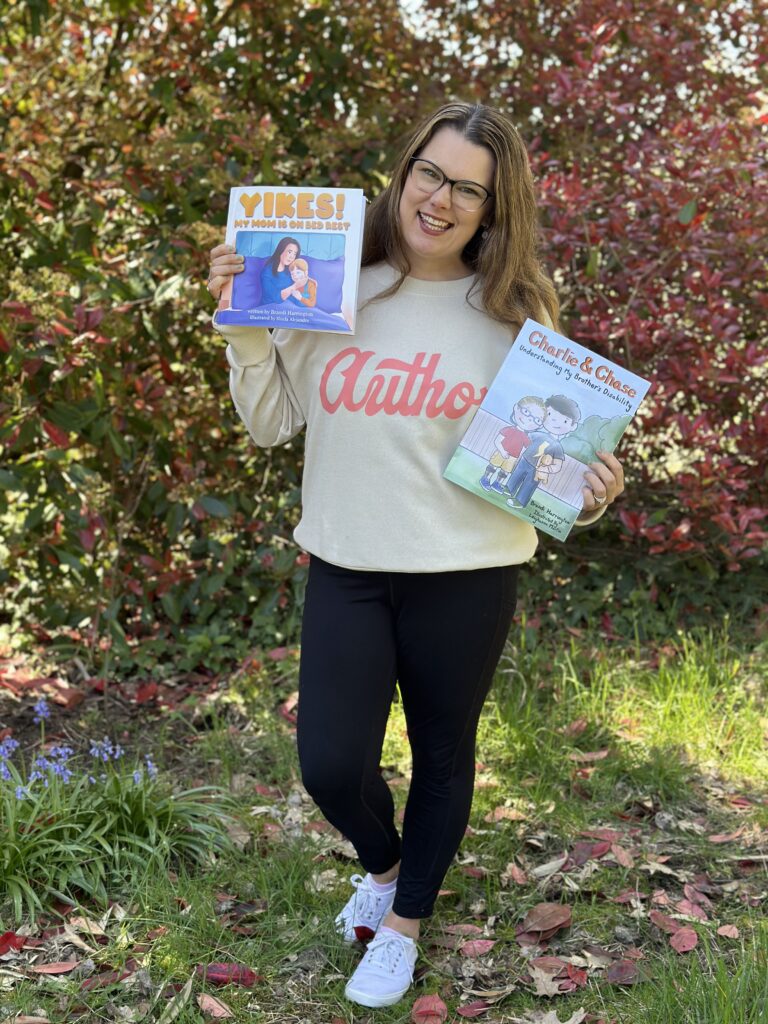
About Brandi
Brandi is a dedicated wife, mother of three, children’s author, and full-time lecturer at a local university. Her journey into advocacy and writing began with a personal challenge that reshaped her life. When her youngest child was 3 ½, he was diagnosed with focal seizures and cerebral palsy. This was due to a lung mass at birth. Despite being given only a 1% chance of survival at birth, her son miraculously beat the odds. Inspired by her son’s resilience, Brandi dedicated her life to helping others.
Driven by her son’s resilience, Brandi has made it her mission to support families facing similar diagnoses. She writes heartfelt children’s stories that offer comfort and understanding. Drawing from her own experiences, Brandi aims to provide hope and practical advice. In addition, she is an active speaker at local events. There, she shares her family’s story and offers guidance to others. Her talks focus on healing, resilience, and community support.
Brandi’s professional life as a university lecturer complements her advocacy work. It allows her to educate and inspire young minds. Meanwhile, she balances her roles as a mother and author. Her dedication underscores her belief in the power of perseverance, love, and the written word. Through her speeches and books, Brandi strives to empower parents and caregivers. She helps them find strength and solace in difficult times.
Episode Summary:
Brandi Harrington shares her journey as a children’s author, addressing medical challenges in her family. She became an author to help her child with special needs and process her own grief. Brandi wrote a children’s book to help siblings understand their brother’s disability, providing practical ways to support people in crisis.
Reflecting on her experiences, Brandi highlights how small gestures can significantly help during difficult times. Practical helps like groceries, meals, and entertainment for children can support people in crisis. She shared how people showed up during a difficult time, including mowing the lawn and running errands. Brandi emphasizes listening to people’s needs and showing up in practical ways; even small gestures matter.
Brandi has published three children’s books (with two more in the works), including “Charlie and Chase,” “Yikes, My Mom is on Bedrest,” and “Wiggles and Shakes: Bennett Learns About Epilepsy.” Her books cover topics such as disability, pregnancy, and epilepsy, and are available on Amazon and her website. She plans to publish two more books on fine motor challenges and explaining leg braces to classmates. Brandi discusses her personal experiences with her child’s epilepsy and cerebral palsy, aiming to educate families.
Brandi recounts her son’s premature birth and subsequent medical challenges, including near death, surgery, and a cerebral palsy diagnosis. She shares how faith helped her cope, with support from medical professionals and the community. Her son was diagnosed with cerebral palsy and epilepsy at 3.5 years old. Brandi struggled to find resources to help her son and his siblings understand his complexities. She discusses her grief, emotional processing, and the importance of seeking help and allowing oneself to grieve.
Brandi and Kandiee discuss empathy, compassion, and understanding towards people with disabilities. They share personal experiences, emphasizing the importance of recognizing and celebrating differences. Brandi hopes her books inspire change, ignite hope in families, and encourage learning about disabilities.