Grief and the many forms of loss with Kandiee Campbell
Kandiee Campbell reflects on loss beyond bereavement, including changes in relationships and work. She shares a personal experience of supporting a grieving friend and discusses journaling as a way to reflect.
Listen
Awaken Hope with Kandiee - Loss
May 16, 2024 · 30:00
Read draft transcript
Automatic transcript with light edits to names and spacing. Some words may be wrong, and speakers are not labeled. Breaks and sponsor messages are included. Check the recording before quoting a passage.
0:00 Are you tired of feeling hopeless, or do you feel as though you carry around an invisible ball and chain? If so, you are in the right place. It's time now for Awaken Hope with Kandiee Campbell. Kandiee is a therapist and grief counselor that works with women to help them process and heal from emotional events that can keep them feeling stuck. Let's take this journey together. And now, here's your host, Kandiee Campbell. Hello, hello, hello, welcome back to the Awaken Hope show, Kandiee Campbell. I am so super grateful that each and every one of you were choosing to turn in. You know, today, in today's episode, I want to talk to you.
0:49 You know I'm a grief counselor, but I really want to kind of address that. Not the grief counselor part, but just knowing how to process grief. And the reason this is coming up today is last night when I was looking through Facebook, I discovered a really good friend of mine. We have been friends since, oh gosh, we were in fifth grade. The story started out as I was in this one class, Mrs. Schweitzer's class. She was my fifth grade teacher, and we were getting ready to move to another location overseas. And a friend of mine, who she became my friend, moved and replaced me in that class.
1:55 And we became, you know, she moved in right before I left, and we became friends. We became connected because she was, as she always said, I replaced Kandiee. You know, she had all my friends, she had my seed, everything that I had went to my friend. And so we have kept in touch throughout the years, and she's, you know, she's a lovely, lovely friend. But last night, I was reading, and I hadn't been on Facebook for a while, and I was reading that her mother, her dear mother, had passed away. And that really kind of took me back a minute. So it was late for Hawaii.
2:54 So I basically, I sent her a text, and I responded to the message on Facebook, but I sent her a text, and I said, you know, I'll call you tomorrow, because it was too late to call her. And so this morning, after a few things, I reached out to her, and my friend is truly still in that early grieving process. Her mother just passed away at the beginning, you know, last weekend, and they just did the memorial service for her. So this is all very fresh and all very raw. But with listening to her, and giving her the air that the space to feel whatever she was feeling, that's truly what I felt led to do.
3:59 But she also knew that I had lost my mom a few years back. And so she, you know, our conversation started with, I mean, I said to her, I'm so truly sorry for your loss of her mother. I mean, she was, her mother was a true soul. She was a beautiful lady. And she just had the kind of start. I mean, they took me and long story, my senior year, I was living with a neighbor that lived up the street, a few houses up the street, and my friend, I will call her T, that's, she basically, she would take me to school because I didn't have a car at this time.
4:46 And she would drive me to school because she had a license that she had a car and drive me and her brother, and then eventually I got a car and then I started taking her brother and myself and we've just been friends for a long time. Let's put it this way. I've known her since I was nine, 10 years old, and I'm in my fifties. So it's been a while. But my point I digress was with listening to her having, she said, I know you know what I'm feeling because she knew that I had lost my mother. And she asked me, she said, what was your experience like?
5:30 And so I began to share my experience of my mom passing away and what led up to her leaving this world. And I shared that, and then she started sharing her experience and all that they had gone through with her mother. Her mother had passed away from a multitude of things, but one being pancreatic cancer and it's just a long complicated story. But I just know that, you know, when we were talking, she, I could sense and feel the rawness that she was feeling, the hurt she's in that numb state. So my point of this is if you are experiencing a loss, now, yes, physical loss is the number one reason why people grieve, okay, losing if someone that's most to you, you do have to grieve that.
6:45 But there are other things that can require you to grieve a loss. And I want you to know that loss isn't just solely death, it can be the loss of friendship, the loss of a job, the loss of a marriage. It doesn't matter where you are, it doesn't matter what your circumstances are. What matters is that you begin to allow that loss and those emotions that come with the loss to come up to the circles. And as I told my friend, the shoes she's walking in right now are not very comfortable, quite uncomfortable, to be exact, and you feel, you know, you will have a range of emotions, you will get mad, you will get sad, you will get, you have joy.
7:57 Maybe not as frequently as you have other emotions come up, but you do get it. But the point of that, and the best tool I can really encourage you to do is begin to journal whatever is coming up, meaning, if, you know, you just get a little notebook doesn't have to be anything really expensive, those notebooks you find at Walmart, or that you get, I mean, they're less than a dollar, maybe a dollar, depending on how thick they are. But you get a journal and a notebook, and you just, no one's gonna see it, you just keep it for you. You keep it where you can, when those emotions are coming up, and those thoughts are coming up, that you can just begin to grow.
8:56 Don't worry about what you're seeing, don't worry about the sentence structure, don't worry about the punctuation and all that, just write, reflow write, meaning you're getting all the emotions, all those thoughts that are rumbling around in your head onto paper. And the quicker we can get them onto paper, the sooner we can begin to let them go. Because all those emotions need to have a space to go somewhere. If we turn off that valve, you not allow ourselves to feel the emotions or to cry or to, to whatever we're feeling, we stuff up. And that, I can tell you, is not a good place to be.
9:50 Because when you stuff, you push it down, and then other things come on top of that, and they create more and more tension, more and more frustration within our body. So, my encouragement is, no matter what the loss is that you're experiencing, or my friend T, it's a physical death of her mother. But understand this, it does not have to be a death to have loss. It can be anything. I had to experience, I experienced loss when both my kids went off to college, because they went off to college and they came home the first year and that was it. And it wasn't until my younger son moved here to Hawaii to attend law school that he came back home.
10:47 He had been, you know, he went to college, he spent four years in the army, living on his own. And then he came back and lived with us for a short period of time until he got married, and then he moved out, which is what he should do. But, going to take a short break, we'll be back, I'll be back, and then we'll continue with this story. All right. Stay tuned. Oh, booking.com. I'm going to somewhere, anywhere, a beach house, a tree house, honestly, I don't care. Hello humidity, fancy hotel with a sexy guard, landscape architect, a tiny home with aggressive wear, somewhere, anywhere, as long as they have child care.
11:46 Booking.com, booking.com. Oh, hello, hello, welcome back to Awaken Hope. I was talking to you about loss. Loss can be, you know, that can encompass grief. Loss encompasses actually a lot of stuff. It's not just physical loss, that is number one reason why grief is the number one reason why we experience loss, but it can be loss of anything. I know for many, COVID changed our lives and brought about loss for people, investments, jobs, you name it, freedom at that time, that moment in time, we had a loss of our freedom. We couldn't just, you know, I mean, here in Hawaii, we were basically locked down in our houses.
12:47 We had limited places we could go. And if we did, we had to, we were out and about and we were wearing a mask and it was just a not so pleasant time to be, you know, to be out and about and around. And we had to be able to, we had to experience that loss of what we perceived as freedom. And yes, it was not very comfortable. And yes, it was, you know, I made a point to travel and do stuff still in light of that, but it was still restrictive. You can have loss when it comes to your children going off to college, going through a divorce or a relationship severing, whether it be an intimate relationship or a friendship.
13:45 I've had friends that have dropped off, you know, I had one that I considered her a friend and she just stopped talking to me. And it was really, really unsettling, but I had to process that. I had to grieve the fact that she was no longer choosing to be a friend of mine and it hurt. It's not easy when you have to process law, but I do encourage, and this is where we were talking earlier, is I do encourage you just to journal it. I have a journal workbook, which you can acquire at the journalingcollective.com. You can use something like that. There are prompts. There are prompts that will give you what you can write about or not what you can write about, what give you an idea or topic of things you should, you can write about.
14:49 But if that's not something you choose to do, and that's okay. If you choose not to use that type of journal, that's perfectly okay. The choice is yours. You can get a notebook and just begin to write because the more, again, the more you write, the more you get all that, those feelings, those emotions, when they come to the surface, you get them out, the quicker you can begin to release them, the quicker you can begin to move on and begin that healing process. Healing comes from processing and dealing with emotions and the hurt and trauma, fears, everything that has our life in a not so positive way, we have to learn to begin to let it go.
15:52 But unfortunately, our brains get in the way. Our head gets in the way and says, oh, you should ruminate about this and you should feel this and you should think about this time and over and over again and that doesn't help us. It doesn't serve anything. For example, my friend T. was talking about the last moments that she was with her mom and she described an experience of what she saw and it wasn't very pretty. It was actually quite horrific in my friend T's mind and the way she described it, it was pretty horrific. But knowing this, and I told her, I said, you know, those last few moments, your mom's physical body was experiencing this because it was a matter of minutes, a matter of minutes to seconds.
16:54 It was a matter of minutes, her body was experiencing this, but the woman that she knew as her mother was not physically there. She had moved on. It was just the body that was going through those horrific events. And she began to, my friend T began to cry as she went to the beginning, she started to release that horrible picture she had in her mind. Because I reset her, I helped her again first breathe to take some few deep breaths and then picture a time, it's all personal to each and every one of you, picture a time where you remember you were happy or you were, you know, she made you laugh or whatever it is.
17:50 And I said, you know, I asked her, I said, do you have that image? And she said, yes, I said, OK, so when that image of your mom and those what you perceived as your mom and those last few minutes come up, you know, you basically tell yourself, thank you, but my mom and you replace it with a picture or an image of when your mom made you laugh or made you smile. And then that way, you can begin to replace those, you know, negative visual images that want to come up and say this is who your mom was because the truth is that was not who her mother was.
18:38 That was those were those last few minutes her body was here on this earth. But her soul, as she knew her mother to be, was leaving the body. So. And you can do this, too. It doesn't matter whether you're dealing with a death or you can you're having a grief, something you replace that negative image with something that brings joy to you, makes you laugh. Like about a time when you were happy with a person or in a situation and focus on that instead of focusing on the negative image or the negative thought, replace those thoughts and those images with something that brings you away, something that brings you happiness and peace.
19:41 And it's not this isn't on us, but you know, and you do a couple of times and then it's better. It's a process. It really is a process. And it takes some time. But the more you do it, the more you replace this not so positive images with better images, the more your mind goes straight to those better images and less do the negative, not some positive images. All right, ladies and gentlemen, I'm going to take a short break. Let's stay tuned. We'll be back and we'll continue with the story. Hello. Hello. Hello. It's Kandiee Campbell from the Awaken Hope Radio Show, and I've got something special for you as a licensed therapist who focuses on [therapy term unclear].
20:35 I've teamed up with a writing coach to bring you a series of journals to help you process your feelings and emotions, hopefully gaining clarity and understanding along the way. If you're ready to embark on a journey of healing, then I've got just the right thing for you, the Hope and Healing 90 Day Journal. Imagine, if you will, having your own compassionate companion, guiding you through the ups and downs, twists and turns of life. That's what our journals are all about. Each page offers you prompts and nurturing guidance to help you reflect, explore and grow. Whether you're facing grief, heartache, or just need a little extra support, the Hope and Healing 90 Day Journal is your safe space to let it all out and find your way back to hope.
21:36 Thank you so much for tuning in and listening. I am so grateful, and I want to remind you that no matter how dark it may seem, there's always hope. So take the first step, and let's link and hope together. Head over to the journalingcollective.com to get your journal now. This will change your life. Thank you. Hello, hello, hello. Welcome back to Awaken Hope. I am so super grateful that you are choosing to tune in. Today we are talking about loss, and if you're just now tuning in, I've been talking about a friend of mine that I've known since I was in fifth grade, but it's been a while.
22:34 He just recently lost her mother, and I saw this yesterday when I had popped onto Facebook and she had posted that her mother had passed away. It just made my heart sad because I have known this family since I was 10. And I'm in my fifties, okay? Things have changed a lot, and she was sweetest lady. Her father was a wonderful man. Her mother's still here, but he was a wonderful man, too, and they were just a wonderful family. But my friend, who I refer to as T, we had a conversation I had called after a message. She called me back, and we began to slowly release some of the emotions she had been feeling.
23:38 I mean, she's still in that numb state, and that's going to happen. You're going to feel numb, and I told her, I said, "It's okay to feel numb. You don't need to, you know, put on a happy face and smile and say everything, because I can't do it in fact. It's not. It's okay to be sad. It's okay to be mad. It's okay to just be numb. No matter what you are experiencing, no matter what type of loss you are going through, whatever you are feeling, it is okay to be right there, and that is truly what we talked about. I mean, she gave me, you know, she talked about her mother's last few months and the experiences.
24:37 She talked about that last moment that she saw her mom's body. And I reminded her that what she saw in those last few seconds was not her mother knew. It was just her body responding before it left, before her, you know, soul completely left this room. And I allowed her to give her permission and reminded her that she could give herself permission to feel whatever's coming up. Journal. I cannot stress that enough. And again, you can get a journal. I have created a journal with writing coach, and it is, you can find it at, my gosh, journalingcollective.com. Or you can get a notebook. It does not matter.
25:54 You want something that has prompts that can give you a direction to go. And I encourage you to get the journal, the journal work 90 days, and it will help you. But in this situation, just get a notebook, do a notebook, write out whatever's coming up. Allow the feelings to come to the surface. It does not matter what you were experiencing. You could be, you could have gotten, you know, be moving along, and then all of a sudden, your relationship pulse goes south or, you know, you get hit with divorce papers. That is, it can be the most unsettling events that kind of stops you in your truck.
26:48 You could have a physical death. You could have a family member pass away, or worse, a child. And yeah, it hurts. I mean, you know, if you've been listening to me for any length of time, you know, in a four year span, I lost my mother, my dad, and my little girl. Actually it was a reversal. My little girl first, and my mother. And you have to grieve that. You have to be okay with where you are and what you're feeling. Nobody, hear me when I say that. Nobody should tell you what you should know. If someone is, you know, most people won't, but you know, there are those people who meet well meaning and say, oh, you should be okay by now.
27:46 No, you shouldn't. If you're not there, you're not there. No reason to move on. You don't want to get stuck and you don't want to just stay where you are, but you've got to give yourself time and permission to grieve that loss, whatever that loss is. You've got to give yourself permission to be okay right where you are. As my friend to you was telling me, she's using that numb state. She doesn't feel real and I understand that. And as I told her, I said, you know, you're going to feel bad for a while and that's okay. It's okay to feel numb. It's okay to not want this to be reality, but to journal, whatever's coming up, give yourself permission to cry.
28:48 Give yourself permission to be angry. You know, oh, if you're angry, use a pillow, hit a pillow, scream into a pillow. I don't encourage you or recommend you do it around kids or animals because they will not, but let it come out. You will be okay. Now take care of yourself and know this. Always hold on to something that gives you hope. Always hold on to something that can help you swing from point A to point B. Take care of yourself and thank you, ladies and gentlemen, each and every one of you. Thanks for listening to Awaken Hope with Kandiee Campbell. If you find yourself struggling, just know there is help.
29:42 Please take the first step and contact Kandiee. To learn more, go to [website address unclear]. If you like our show, please tell your friends and family to listen. Join us again next time for Awaken Hope with Kandiee Campbell.
Topics
- grief
- journaling
- supporting others
Awaken Hope With Kandiee
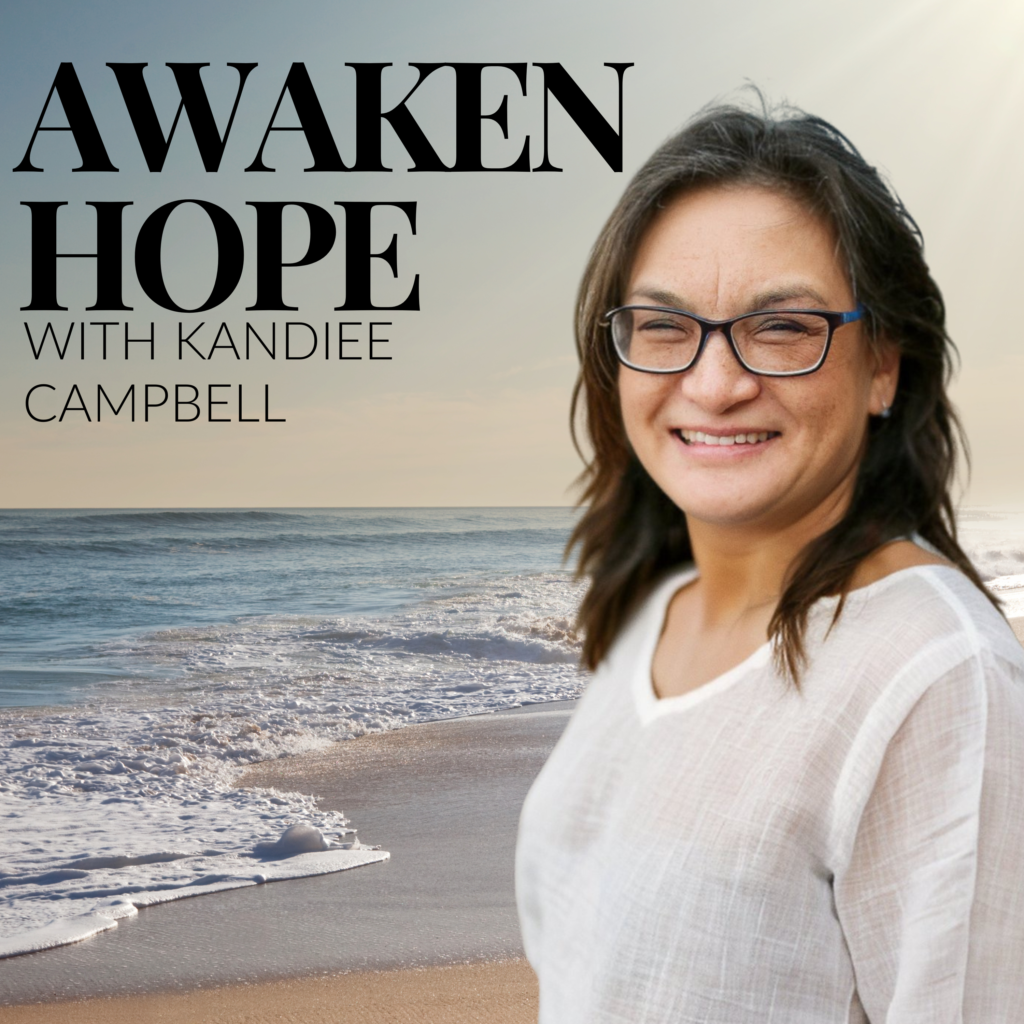
In this episode, I explore the many forms of loss, from death to relationships, and shares personal insights and advice on processing grief and finding healing.
Loss
In this episode, I shared a deeply personal experience about comforting my friend T after her mother passed away. This profound moment made me reflect on the different types of loss we all go through—not just the loss of a loved one but also the loss of relationships, jobs, and other significant parts of our lives. I aimed to highlight that all these forms of loss are valid and deserve our attention and care. Additionally, I talked about the power of journaling as a way to process these emotions and release the tension that comes with them.
I strongly encouraged listeners to give themselves permission to feel whatever emotions come up, whether it’s sadness, anger, or even numbness. Drawing from my own experiences with losing family members, I know how important it is not to suppress these feelings. Instead, I recommended replacing those negative thoughts and images with positive memories of the people we’ve lost. Ultimately, this episode is about acknowledging and processing our emotions so that we can heal and maintain our physical and mental well-being. My hope is it resonates with everyone who listens.